Technical Writing for Manufacturers
Technical Documentation Across the Product Lifecycle
Technical documentation for the people who design, build, install, operate, maintain, sell, and support complex products.
AEC helps manufacturers turn engineering information, product knowledge, production processes, and technical requirements into clear, organized content. We develop documentation for both the products manufacturers deliver and the internal teams responsible for building, inspecting, testing, installing, and supporting them.
Our work includes manufacturing and assembly instructions, operation and maintenance manuals, installation procedures, illustrated parts information, product presentations, training materials, and other technical content. We can create new documentation, improve existing content, or provide ongoing support as products and processes change.
This support helps manufacturers reduce demands on engineering teams, improve production consistency, and keep documentation current as products and processes change.
AEC's quality management system is certified to ISO 9001:2015 and AS9100D, supporting consistent planning, review, configuration control, and delivery.
AEC also supports aerospace technical writing, defense and government technical writing, and transportation technical writing programs, and provides technical writing services, technical writing outsourcing and contract writers, and technical documentation services and solutions across industries.
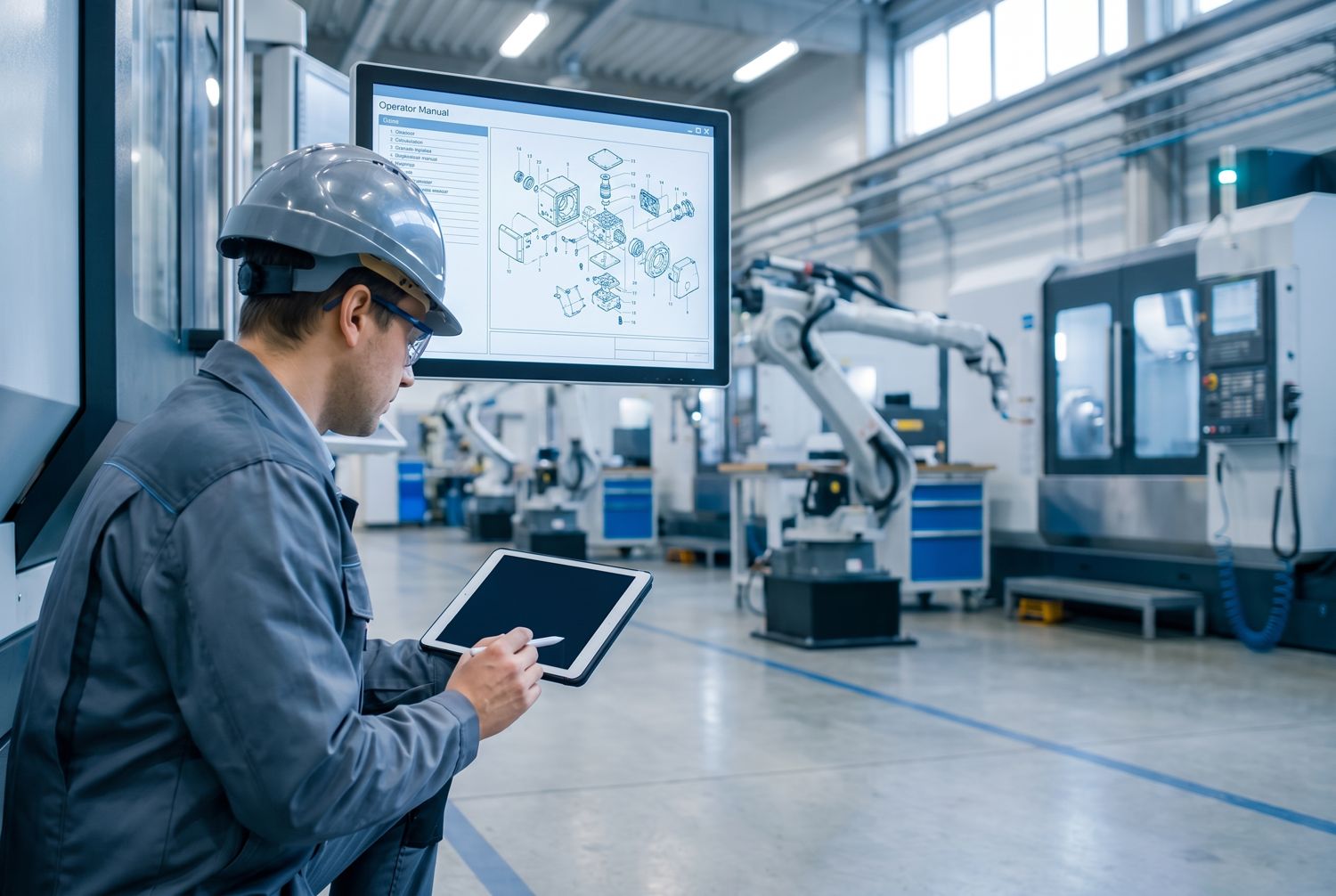
Manufacturing Documentation and Technical Content
AEC develops, revises, and maintains documentation supporting production, installation, operation, maintenance, service, and customer communication.
Production and Work Instructions
Step-by-step instructions for assembly, fabrication, installation, inspection, testing, rework, changeovers, quality checks, and other production activities. These documents help turn design requirements into repeatable production work.
Operation, Maintenance, and Service Manuals
Instructions for safely operating, inspecting, maintaining, troubleshooting, adjusting, and repairing equipment and systems. Documentation may include preventive-maintenance procedures, troubleshooting information, removal and installation procedures, and testing requirements.
Installation and Commissioning Documentation
Site requirements, unpacking, assembly, mechanical and electrical connections, configuration, startup, testing, and acceptance procedures used to place products and systems into service.
Illustrated Parts and Product Information
Illustrated parts catalogs, parts manuals, exploded views, bills of materials, configuration information, and related content used to identify assemblies, components, part numbers, quantities, and applicable configurations.
Setup, Adjustment, and Configuration Manuals
Instructions for configuring complex or highly adjustable products for different operating conditions, applications, environments, or performance requirements.
Technical Presentations, Training, and Product Content
Technical presentations, training materials, job aids, product literature, brochures, data sheets, and branded technical content used to explain complex products, processes, capabilities, and applications.
What a Manufacturing Technical Writer Does
Manufacturing companies build complex products, but the people who design them are rarely the people who install, run, service, or order parts for them. A manufacturing technical writer bridges that gap. We interview your subject-matter experts, read the engineering drawings and specifications, and where appropriate observe the equipment, then convert what we learn into documentation a real audience can use without guesswork.
Done well, technical writing for manufacturers does several jobs at once. It reduces downtime by giving technicians correct procedures the first time. It captures hard-won knowledge before an experienced employee retires or moves on. It shortens onboarding and training. It cuts support calls and warranty claims caused by misuse. And it standardizes how procedures are written, so a maintenance step reads the same way across every manual in your library. Inconsistent, ad-hoc documentation is one of the most common usability complaints from end users, and it is the easiest to fix with a disciplined writing process.
AEC delivers this work through technical writing services that can run as a fixed-price project, on a time-and-materials basis, or as outsourced and contract writers who augment your internal team.

Experience Across Manufacturing
AEC supports manufacturers of industrial equipment, aerospace products, energy systems, building products, specialty vehicles, and other complex mechanical, electrical, and software-enabled systems.
We work with both established manufacturers and emerging companies, supporting needs that range from individual publications and production programs to broader documentation libraries and ongoing technical-content support.
Writers Who Understand the Product and the Work
AEC's writers do more than record information provided by engineers and Subject Matter Experts. They review drawings, specifications, bills of materials, schematics, software interfaces, existing procedures, and other source data to develop a practical understanding of the product and the work being performed.
Our team includes former mechanics, technicians, engineers, inspectors, illustrators, editors, software professionals, and experienced technical writers. This background helps us:
- Interpret complex engineering and product information
- Identify gaps, conflicts, and missing source data
- Ask informed technical questions
- Provide practical feedback on procedures and content
- Work independently when adequate source material is available
- Use engineers and other experts efficiently for clarification and validation
When appropriate, AEC can also support onsite research, equipment observation, procedure walkthroughs, and collaboration with production, installation, service, and support personnel.
What Our Customers Say
The overall experience has been wonderful using AEC. The response from AEC is excellent, always on time with project deadlines.
The value is exceptional to our company. Our customers demand quick and timely response from us, and we depend on AEC to help provide the correct timely response.
I would highly recommend AEC because of the overall experience, the timely manner that our projects are resolved and the friendly staff always available to answer all of our questions.
Field Service Manager, Airline Seat Manufacturer
We've had an amazing experience working with our AEC contact. She's incredibly responsive, produces great work, and does so in a timely manner without rushing or making mistakes for the sake of speed.
Major North American Manufacturer
Improving Existing Documentation
Manufacturers often have manuals and procedures developed over many years by different teams, facilities, and suppliers. The result may be outdated content, inconsistent terminology or templates, duplicated content, and documents that are difficult to maintain.
AEC can help update, reorganize, standardize, convert, and rebrand existing technical content. We can also establish common templates, terminology, document structures, and practical revision processes.
Legacy modernization is a common request. Many manufacturers hold years of documentation in flat PDFs or aging Word and FrameMaker files that are hard to update and impossible to reuse. Converting legacy content into FrameMaker or structured DITA/XML makes it single-source, easier to translate, and far cheaper to maintain as products evolve. We scope the conversion approach to your source material and goals.
Learn more about our Technical Documentation Services and Solutions.
Standards, Safety, and Customer Systems
AEC develops documentation to applicable customer requirements, product standards, contractual requirements, and safety conventions. We work within customer-defined templates, terminology, review processes, and authoring systems.
AEC commonly works in Adobe FrameMaker, Microsoft Word, Adobe InDesign, Siemens, PTC, and other customer-selected software.
Standards and Compliance Good Manuals Account For
Several recognized standards shape how professional manufacturing documentation is written. Here is what they cover, explained as general industry knowledge so you can scope your project intelligently. AEC produces documentation that supports compliance with the standards relevant to your product; which specific standards we apply on your project is something we confirm during scoping.
- ANSI Z535.6 governs how safety messages appear in product manuals and collateral, including the signal-word hierarchy of DANGER, WARNING, and CAUTION for injury hazards, plus NOTICE for property or non-injury risks. The standard addresses how safety messages are structured and placed in a manual, covering grouped safety sections, section messages, and messages embedded in steps.
- IEC/IEEE 82079-1 is the international standard for preparing instructions for use. It is a horizontal standard spanning simple products through complex industrial machinery and software, and it informs how complete, findable, and usable a set of instructions should be. In the EU, following relevant harmonized standards can confer a presumption of conformity for CE directives.
- ISO 9001 quality-management documentation, OSHA safety and lockout/tagout practices, and structured content with DITA/XML for reuse, single-sourcing, and translation efficiency round out the landscape most manufacturing buyers care about.
An important accuracy note: in the United States, applying these standards is largely voluntary, but it is frequently required contractually or commercially by importers, distributors, insurers, or certification bodies. Legal compliance for CE marking, OSHA, or similar always rests with the manufacturer, not the documentation vendor. Good documentation is built to support your compliance obligations; it does not transfer them.
Flexible Ways to Work With AEC
AEC can support a complex standalone publication, temporary workload increase, new product launch, or long-term documentation program.
Fixed-price projects
AEC completes a clearly defined scope for an agreed price and schedule.
Hourly project support
AEC provides flexible support billed for the actual time required.
Embedded writers and dedicated teams
AEC personnel work as an extension of the customer's organization.
Managed documentation programs
AEC coordinates the resources and day-to-day execution required to maintain a publication set, backlog, or recurring workload.
Learn more about our Technical Writing Outsourcing and Contract Writers services.
From Data to Done
From scope and source review to delivery and ongoing lifecycle support.
Scope and Source Review
We review the product, audience, available source material, required deliverables, software, standards, responsibilities, and schedule.
Authoring and Illustration
AEC writers and illustrators develop the documentation in the required format, template, authoring environment, and customer process.
Quality and Customer Review
Content moves through the appropriate quality reviews and customer review or Subject Matter Expert validation, as applicable. Comments, corrections, and technical decisions are incorporated and tracked.
Delivery and Lifecycle Support
AEC delivers the required files and can continue supporting revisions, product changes, configuration updates, conversions, and recurring documentation needs.
Frequently asked questions
They are written for different readers at increasing depth. An operation manual is for the equipment operator and covers normal use, safety, and routine upkeep. A maintenance manual is for maintenance technicians and covers preventive, predictive, and corrective tasks, schedules, and troubleshooting. A service manual is for repair technicians and is the deepest, with wiring diagrams, component breakdowns, diagnostics, and repair procedures. Many products need more than one.
A user guide is task-oriented and shorter, walking readers through specific goals. A user manual is a comprehensive reference covering the full feature set and specifications. Dense electrical, systems, and software products often benefit from both: a concise guide for everyday tasks plus a complete manual for the full picture. We help you decide during scoping based on your audience and product complexity.
An IPC pairs technical illustrations with parts tables so a reader can identify a component visually and order it correctly. Each view is keyed to a table that typically lists an item or position number, part number, part name, and quantity, organized by system or assembly. The goal is accurate parts identification and ordering, which reduces costly wrong-part errors. AEC produces illustrated parts catalogs as a standard deliverable.
A strong PM procedure has a title and ID, a clear purpose and scope, the responsible role, required tools and materials, and a safety and lockout/tagout section up front. Steps are verb-first and numbered with one action per step, with specifications and tolerances called out and photos on the physical steps. It closes with a verification and sign-off step so completion is documented. The most reliable procedures are drafted with help from the person who performs the task, then reviewed at least annually or whenever equipment, process, or regulation changes.
Yes. We can run a project as a fully outsourced team or place writers embedded with your staff, whichever fits your workflow. Engagements can be priced as Time and Materials or Fixed Price. You can read more on our outsourcing and contract writers page.
No. Documentation is built to support your compliance obligations, but legal compliance for CE marking, OSHA, and similar requirements rests with the manufacturer, not the documentation vendor. In the United States, applying documentation standards is largely voluntary, though it is often required contractually or commercially by importers, distributors, insurers, or certification bodies. We confirm which specific standards apply to your project during scoping.
Talk to a Manufacturing Documentation Expert
Tell us about your product, production process, technical content, or documentation challenge. We can help determine the appropriate scope, team, deliverables, and engagement approach.